

Last summer I entered a writing competition hosted by Writers’ Playground. The Internet is chock-a-block with competitions to choose from, each with a different format. I chose this one because it offered one-on-one feedback and because it came with constraints which I knew would challenge my attempts at writing fiction.
On July 10th the organizers sent a set of prompts and entrants had 10 days to write a maximum 3,000-word story based on the chosen prompts.
Here were the rules:
CHOOSE ONE OF THE CHARACTERS LISTED BELOW. This character does not have to be your protagonist, but they must play a significant role in your story.
A fugitive
A queen
An amputee
A carpenter
A teenage prodigy
CHOOSE ONE OF THE SETTINGS LISTED BELOW. Can be set in any time-period, including the future. Can deviate slightly but the majority of the story must take place in one of these settings.
A summer camp
A vineyard
A production studio/film or tv set
A rehabilitation center
A treehouse
THE ONE THING THAT MUST BE INCLUDED IN ALL STORIES IS:
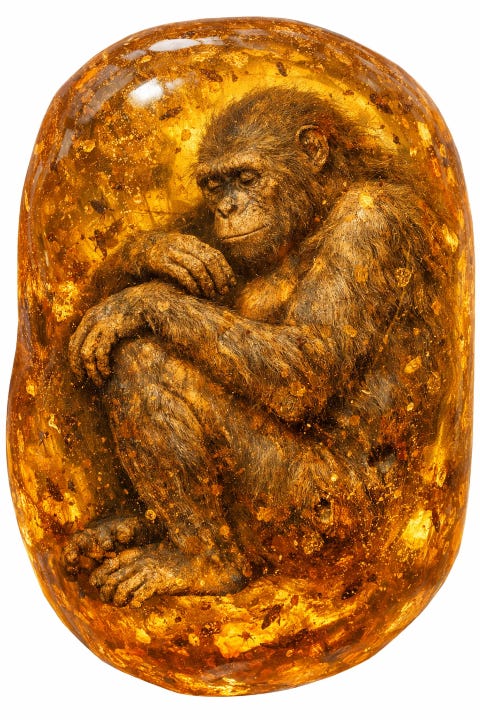
A piece of amber with something relating to or derived from living matter preserved in it.
I set to work using the prodigy and vineyard and submitted my story with about 36 hours to spare.
There were almost 700 entrants, and it took until October for the feedback to arrive, but when it did it was helpful and encouraging and called for stronger character development. ( I was well into writing a novel at that point and took some of the advice and applied it to parts of the novel which is now in at least its third draft.)
Here is the revised contest entry sticking to my original story and still coming in under the 3,000 word limit.
Hope you enjoy it and feel free to add your own suggestions on character development.
El Graeco
The Ape was not yet a mature female, but she was big. Normally moving on all fours, she was close to five feet tall when she rose up to survey her surroundings. At age seven she was still a teenager but already weighed 400 pounds. She had a vision that she would challenge the leader of her matriarchal troop, but right now she was in pain. Her mouth hurt. It stung to chew on the tubers she dug from the ground and biting down on her favourite nuts was impossible. The pain was so intense she chased off the males wanting to mate. Munching on handfuls of leaves was all she could manage and she would starve if the pain did not go away.
Neel was bored. His parents had packed him off to Greece to spend time with his relatives who owned a vineyard, leaving his beloved books behind in his Danforth-area home.
“I know you’re a smart kid,” his father had said as his first year of high school was winding down, “but you need to experience more than just books and the museum. You need to experience life BEFORE it makes it into a museum or a book.” Neel didn’t want to experience life. He had enough of that coping with a new school and being the odd kid in his class.
He had met Aunt Areti and Uncle Anastasios a couple of times when they had come to Canada to visit and grudgingly admitted they were cool. An old family, they were full of new ideas to revive traditional Greek winemaking. Working for the summer in their vineyard however, was not what he wanted. He had hoped to have another summer learning how to catalogue fossils; but here he was, waiting for his uncle who had said they were going for an “outing” this morning. An outing he did not need or want.
“Come with me,” Anastasios said. He handed Neel a knapsack. “There is food and water for you, and you’ll need this as well.” From inside his own knapsack, Anastasios produced a sheath holding a large, curved knife.
“Where are we going?”
“We are preparing to harvest the resin from our Aleppo trees up where the vine rows meet the hillside.”
It was early and the temperature had not started to rise, but Neel was not used to strenuous activity and was soon labouring as they climbed up the hill. Anastasios tossed him a straw hat. “You’ll want this.”
“We make retsina, Neel. It’s a Greek wine that has been around for at least 4,000 years. My family ― your family ― is trying to bring it back to life. The key ingredient is the resin of the Aleppo pine tree. We grow the grapes carefully in our vineyard, but we harvest the resin just as the tree offers it. Our trees have grown in the soil of our family vineyard for generations and some of the individual trees are 150 years old. The whole forest is as old as these hills. We look for mature trees to preserve the traditional flavour we add to our wine.”
The path led them higher up and once they were into the forested area where it levelled out and was cooler, Neel felt better. “We’re almost there,” his uncle assured him. “You should be able to catch the fragrance of the pine needles as they warm up from the sun hitting them.”
Neel took a deep breath and experienced a smell unlike anything he had come across back home. Was this how it smelled millions of years ago? As the sharp aroma of wild thyme hit him, he could visualize what it would have been like.
He excelled in school because of his exceptional memory. A memory that was as much a gift as it was a curse. He remembered big things and tiny details. Sometimes it was those tiny details that left him confused as he tried to sort out what was important, what was interesting, and what really didn’t matter. It made him different from everyone at school. He had read up on this part of Greece once he knew there was no choice but to accept his summer fate; picking out the bits that were most important. How had the early hominids wandering Eurasia ended up as people like his aunt and uncle? How had land once covered in dense forests become beautiful hillside vineyards? He learned that this part of Greece had been home to Graecopithecus macedoniensis who had died out seven million years ago. His knowledge of the prehistoric world helped him link it all together and he started to form images of how things happened.
The pain was becoming too much to bear and the big Ape reached inside her mouth desperately looking for what was causing the pain and cried out when she touched the tender spot. There seemed to be nothing she could do to stop the hurt and with her powerful hands, tore a branch off a nearby tree, and poked inside her mouth to push away her pain. Her nose twitching at the unfamiliar smell from the branch.
Neel and his uncle passed through the tree cover and into an area that was more open with dry rocky soil before it gave way to steeper slopes beyond the vineyard. The aroma of the Aleppo pine was strong and unmistakable. Anastasios told Neel he had made a trip up here weeks earlier and marked many of the trees with bright red ribbons. He pointed at the pine grove.
“We are after the trees that are marked.” Anastasios pulled his curved knife from its sheath and motioned for Neel to ready his own knife. “We need to get the resin flowing by wounding the tree but not wounding it enough to kill it.”
Neel could see the reverence his uncle had for the trees and imagined the scene at this very tree 150 years earlier. His ever-wandering mind took him further back to ancient Greece and then to this same grove ten thousand years ago, then ten million years. He saw creatures roaming right where they were standing now. As his uncle talked, Neel was casting back to scenes of whole species, now long gone.
“Hey! Neel, pay attention. You get lost inside that cluttered head of yours?”
“Sorry, Uncle; yes. I like to think about what it was like here long ago.” He remembered the online references he had found while waiting for the flight from Canada. “There are some theories that say common ancestors of great apes and humans—you know like you and me—actually lived here and migrated to Africa; not the other way around.”
“Well Neel, focus on the job at hand. You can solve the mysteries of mankind another time. Watch carefully.”
Anastasios made several long, shallow cuts in the trunk of one of the pine trees, then moved on to the next one.
“We leave the blade dull intentionally so we don’t cut too deep. You’ll have to apply pressure to start the cut, then pull down slowly.” Neel took the curved edge of the knife and made a hesitant first cut, which released a stronger, mustier aroma. His uncle nodded, and Neel made another cut. They moved across about two dozen trees, making several cuts in each one; Neel feeling more confident with each cut.
“Now, let’s go back and look at the first one we did.” The tree had started to slowly ooze resin. Neel knew it was meant to protect the tree when it sensed it was being attacked by insects or disease, or to seal off physical damage but to his mind it looked like the tree was bleeding. A glistening, honey-coloured blood that caught the light of the mid-morning sun.
“Go ahead,” his uncle said. “Taste it.”
Neel dipped his finger in the sap and licked it off. “Tastes almost like it smells. Like pine. Bitter and sweet at the same time. Makes my tongue feel odd.”
“That’s about right. We’ll come back in a week to scrape off the hardened resin then prepare it to flavour our wine. Now let’s have something to eat.”
They sat on a fallen tree in the grove of trees downslope from the Aleppo pines to eat the food they had brought with them. Neel pointed up past the trees to where the slope became more rugged, with small cliffs and stony outcrops. “What’s up there?”
“I suppose millions of years ago it was much more rugged than now, but you might find it interesting. There are a few small caves which were inhabited in the past by wandering bands of nomadic herders. You still see feral goats descended from those old herds. Rumour has it those nomads found amber which they used for trading. We had some archeologists from the university in Athens poking around a few years ago, but I don’t know what they found. Or if they found anything at all. You should head up there tomorrow.” He gave Neel a wink and a playful nudge. “No telling what a young genius like you will find.”
The big Ape began to rock back and forth and whimper. One of the adult females in the troop settled beside the Ape as she closed her eyes to slits, hoping sleep would allow her to forget the pain. She had no idea what it meant to have a broken tooth. All she knew was that something was terribly wrong. She put her head on the female who had come to comfort her and grunted each time a new wave of pain shot through her mouth and jaw.
When they made it back down to the vineyard, Neel went straight to his room to study up on what he had seen and felt earlier in the day. He went online and learned more about Graecopithecus macedoniensis ―nicknamed El Graeco ― and the era it lived in before the entire genus died out. He studied the Aleppo pine. He learned more about resin. By the time his Aunt Areti called him for dinner, he knew everything he needed to know before going back up the hillside the next day. Over the evening meal he couldn’t stop sharing everything he learned. The teen’s headful of science and history seemed to make more sense here; surrounded by trees that had witnessed generations of families and smells that had been around for thousands of years.
“I was right; there used to be ape-like animals here at least seven million years ago. I read the research papers. Huge apes that could have been scrambling around those very cliffs before coming down to forage for food in the forests that covered your vineyard. They would have eaten wild walnuts and nuts … kinda like pistachios” He pointed at the salad his aunt had made. “Just like the ones you have in there.”
Boredom was no longer a problem for Neel and for the rest of the meal he spilled out all the ideas he had trapped inside his head. He went on about a Miocene fossilized jawbone discovered near Athens that supported the idea that pre-humans lived in Greece. “They could have been here in your vineyard!”
“And I found the research paper written by the team you said had been here, Uncle. They didn’t find any hominid fossils, but they also said there was no reason to believe that pre-humans had not lived here and there is another dig planned soon because they are sure there is evidence to be found in those caves.”
Anastasios and Areti ate mostly in silence, letting their nephew release his new energy. Areti promised to make lunch for the next day and said there would be a small flask of retsina so he could truly experience what generations of families had come to know. “A very small flask, mind you,” she said and smiled.
The Ape tried looked around the forest trying to distract from the pain. She noticed a brightly-coloured substance oozing from the tree where she had torn off the branch earlier. It was something she had not paid attention to before but it was a new smell, and she reached out to touch it with her long forefinger. It was soft and stuck to her. She was hungry and this would not need her to bite down, so she licked it off her fingers. It had a bitter sweetness her palate did not recognize which made her lips tingle. She scraped fingerfuls off the tree and stuck them in her mouth until her lips and gums were numb. It went down easily, and she did not stop until there was none left on the side of the tree. She would look for more.
Neel set out early. On my own! he thought to himself. He wore the straw hat his uncle had given him the day before and in addition to the food, the small flask of retsina, and a couple of bottles of water, he still had the curved knife for cutting the Aleppo trees. He passed through the rows of Assyrtiko grape vines—Vitis vinifera species he noted to himself—which his aunt and uncle used to make the wine which would be flavoured later with resin. He passed through the forest, too busy identifying every plant and tree he saw to realise how quickly he was climbing. He finally made it to the family Aleppo grove and continued up to the base of the cliffs stopping often to wipe the sweat from his eyes.
He poked and clambered around the rocks and went into the caves he guessed the archeological team had been exploring, mapping it all out in his mind. Even better than indexing fossils, he thought.
The pain in her mouth was beginning to ease. She couldn’t bite down on hard nuts, but managed berries and leaves that helped ease her hunger and searched for more of the sticky sap. Some of it she could lick off her fingers right away, other parts were gummier but could be chewed carefully.
Neel continued to roam the cliffs and mentally catalogued every spot he wanted to return to. By noon he was hungry and sat in a cave entrance, just out of the full sun to eat the fruit, nuts, and fresh vegetables and indulge in sips of the still cold retsina. He sat back and tried to imagine El Graeco in this very cave, maybe seeing the same pieces of sparkling rock that he was seeing. They would have hidden here for the night and in the morning moved down the hillside toward the vineyard, stopping to pull wild walnuts or pistachios off the trees or dig for wild garlic or the prehistoric tubers that looked like carrots. Neel stood up and marched down the rocky slope. The same slope he knew early hominids had walked. He tripped on the scree and scraped his hand but ignored it as he hurried to soak in the scene of an Aleppo grove that had once been full of apes.
Chewing remained difficult for the Ape, but at least it was now possible. Digging for tubers yielded treasures that were not too hard on her mouth. She was surrounded by trees that had more of the sticky food she now knew was helping ease her pain. She scraped off more and started chewing it while the small group stopped to rest before heading back to shelter in the rocks as darkness approached. She was still chewing when they finally settled for the night.
Neel’s hand was stinging from his fall when he reached the grove where he decided El Graeco would stop to rest so he decided to do the same. He knew about the medicinal qualities of resins and in particular the resin of the ancient Aleppo pine. He took out his knife and made a shallow cut on one of the trees to get some of the resin while it still oozed freely and which he could easily spread on his hand. He knew that resins were traditionally used to relieve pain whether applied to a wound like he was doing, or as a poultice for abscesses.
He sat down against a tree and as he imagined the troop heading back up the slope to shelter against the rocks for the night, he suddenly thought about one of the caves he had catalogued in his head. He remembered what his uncle had said about the nomads finding amber to use in bartering and trade. Resin hardens over millions of years to form amber which is both beautiful and often contains pieces of ancient history trapped in a golden-coloured and reflective gem.
He turned and moved as fast as he could back to the cave where he sat in the exact spot where he had stopped to eat earlier.
Closing his eyes, he tried to remember where the sun had glinted off something stuck in a crack running through a rock. He opened his eyes, spotted it, and moved to pick it up. I am the first human ever to touch it.
Encased in amber that had taken millions of years to form from the Aleppo resin, was a tooth.
As total darkness settled in, she was still awake and chewing the gum she had started earlier. She rolled it around with her tongue and felt something hard. She spit it out against the wall of the cave and saw that a tooth had come out, covered in the goo.
By the time the sun rose, and it was safe to move, the Ape was herself again but she still felt uneasy. The troop was now waiting for her to lead the way; they trusted her new vision, but as she surveyed the landscape below, she was unsure which way to take. The vision of their future was blank.
I liked the way you brought the two timelines together